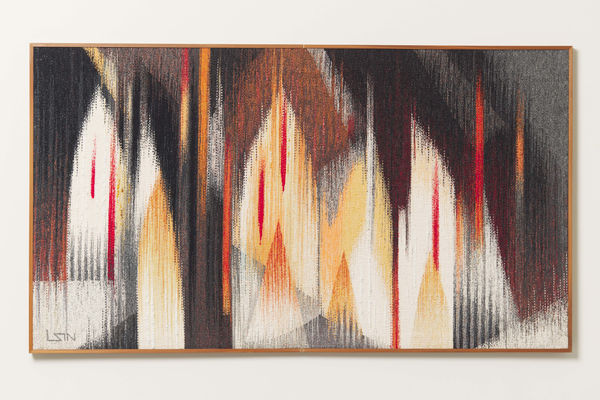
Lee ShinJa: Weaving the Dawn
-
-
Born in 1930 in Uljin, Korea, while the country was under Japanese colonial rule, Lee first encountered textiles through the women in her life. As a child, she played with her mother’s sewing rings, and watched her grandmother weave cloth for household use. In a 1977 conversation with critic Yoo Keun Joon, she remarked that it was natural for women to gravitate towards embroidery within the limited scope of applied arts at the time.[1] Her innovative spirit can be felt early in her practice when she boldly integrated appliqué and dyeing into her embroidery. In Image of the City (1961), she unraveled the plain weave of the base fabric and twisted subtly colored threads to the loosened ones to create a structural tension previously unseen in traditional textiles. Meanwhile, Portrait of My Daughter (1962), modeled after her second daughter, broke formal embroidery conventions with its semi-abstract representation of a face and hands. Lee’s experimentation with technique and form reaches a crescendo in Screen (1979), which divides space by introducing thick cotton yarn to a deconstructed linen cloth. Lee’s avant-garde approach and subversion of the boundaries between craft and fine art, as well as traditional and modernist technique, received mixed reviews at the time. Some critics claimed that she was destroying the practice of Korean embroidery. Others hailed her as a comet in the craft world.[2]
In the 1970s, Lee fully embraced tapestry techniques, developing new dyeing methods and experimenting with unique materials such as bedding and wool sweaters sourced from secondhand markets. Her works from this period, such as Sun and Moon I (1973), feature geometric motifs, lyrical colors, and harmonious horizontal and vertical compositions, achieving a complete abstraction. In the 1980s, after visiting the 1970 Osaka Expo and the 1983 Lausanne International Tapestry Biennale, Lee gained the confidence to expand her textile forms into sculptural installations. During this decade, she also met and engaged with international artists like Magdalena Abakanowicz and Issey Miyake through textile exhibitions at the National Museum of Modern and Contemporary Art, Korea. Reflecting her remarkable dedication, Lee’s large-scale woven works became increasingly experimental, incorporating bold colors and extensive weaves. Despite her prolific output, she faced personal sorrow in 1982 with the passing of her husband, painter Chang Woon Sang.
Amid this loss and the challenges of being a single parent, Lee discovered a profound passion for creation. From 1984 to 1993, she had three solo exhibitions with works expressing a resilient will for renewal stemming from the artist’s deep reverence for nature’s life-sustaining and cyclical forces. Pieces such as Dawn, Legend, and The World is Beautiful transform images of nature through abstraction: Their densely populated and meticulously layered threads evoke the sky, wind, sunlight, and ocean, suggesting a powerful vitality rising from the earth and a sense of coexistence, hope, and expansion. Critic Kim Bok-Young articulated this as themes of “metaphor of light” and “space of memory” in Lee’s oeuvre.[3]
Reflecting on her childhood memories of nature, Lee said, “Growing up in a rural area, I vividly remember the intense sunlight at sunrise and sunset. I have cherished memories of climbing mountains with my father every morning to witness these moments. The sunlight rising from the East Sea left a lasting impression on me. I have always believed in creating nature as I see it. However, I still feel that my work has yet to match the beauty of my hometown.”[4]
After her 1993 solo exhibition, Lee focused on further developing her abstract representations of nature in her “Spirit of Mountain” series. This body of work, which epitomizes her later practice, uses a variety of materials to portray dynamic mountain ranges through intricate diagonal structures. Since the 2000s, Lee’s work has highlighted sculptural abstraction and spatial depth by incorporating new materials such as wood and metal into her tapestries. While maintaining her characteristic color palette of red, yellow, black, and gray hues, she has introduced tonal contrasts, enhancing vertical and horizontal structures to create a more static composition. Her serene landscapes often feature rectangular shapes reminiscent of windows, drawing inspiration from traditional Korean houses, or hanok. Seen through these frames, Lee’s mountainous forms reflect her tranquil and humble vision of simultaneously observing and residing within nature.
Critic Kim Hong-hee, former director of the Seoul Museum of Art, commended Lee’s achievements in challenging gender and genre biases in craft.[5] Furthermore, she observed that Lee’s fiber art subtly reflects autobiographical elements, despite their formally abstract style, offering a foundation for feminist critique. “Weaving the Dawn” seeks to reinvigorate this conversation around historically marginalized artistic practices that have been overlooked due to their associations with women’s domestic labor.
[1] Yoo Keun Joon, “Cover Story, Lee ShinJa and Yoo Keun Joon’s Conversation: Amiable Everyday Life Sculpture,” Monthly Design, June 1977, 5.
[2] Lee ShinJa, oral statement recorded by Choi Gongho, The 2013 Oral History Project of Modern and Contemporary Arts in Korea, Series 230: Lee ShinJa. ARKO Arts Archive, 2014.
[3] Kim Bok-Young, “Metaphor of Light and Space of Memory,” Monthly Art, 1993.
[4] Lee ShinJa, oral statement recorded by Choi Gongho, The 2013 Oral History Project of Modern and Contemporary Arts in Korea, Series 230: Lee ShinJa. ARKO Arts Archive, 2014.
[5] Kim Hong-hee, “Lee ShinJa’s Fiber Art: Breaking the Genre and Gender Bias in Craft,” in Lee ShinJa, Threadscapes (Gwacheon: National Museum of Modern and Contemporary Art, Korea, 2023).
-
-

-
-
Lee ShinJaSpirit of Mountain, 1998Wool, synthetic thread, and metal; tapestryFramed:
31 1/2 x 43 x 3 in
80 x 109.2 x 7.6 cm -
Lee ShinJaSpirit of Mountain, 1997Wool, synthetic thread; tapestry23 5/8 x 33 1/8 in
60 x 84 cm
Framed:
25 1/4 x 35 x 1 7/8 in
64.1 x 88.9 x 4.8 cm -
Lee ShinJaSpirit of Mountain, 1994Wool thread, metal; tapestry24 x 31 1/8 inches
61 x 79.1 cm
Framed:
25 1/4 x 32 1/4 x 1 3/4 in -
Lee ShinJaImage of Light, 1987Wool thread; tapestryFramed:
46 1/2 x 82 x 2 in
118.1 x 208.3 x 5.1 cm
-
-
News
-

Lee ShinJa’s “Weaving the Dawn” Exhibition Brings Seven Decades of Fiber Art to New York
stupidDOPE August 28, 2024Artist Lee ShinJa weaves together autobiography and abstract beauty in her solo exhibition, “Weaving the Dawn,” now on view at Tina Kim Gallery in New...Learn More -

'Weaving the Dawn' Spotlights Seven Decades of Lee ShinJa's Fiber Art
Hypebeast August 27, 2024Lee ShinJa’s tapestries begin and end at the crest of the Uljin mountains. Her work braids together autobiography and fractal abstractions into the shape of...Learn More -

6 New York Shows to See during Armory and into Autumn
Ocula August 27, 2024Anticipating New York 's Autumn art fair season this September, we have selected six must-see exhibitions. From Lee ShinJa's intricate tapestries at Tina Kim to...Learn More -

At 94, the Pioneering Lee ShinJa Weaves a New Tradition for Feminist Textile Art
Colossal August 22, 2024When artist Lee ShinJa was born in 1930 in Uljin, Korea, during a period of Japanese colonial rule, textile traditions were largely rooted in domestic...Learn More -

Lee ShinJa Weaves a New Dawn at Tina Kim Gallery in New York
Whitewall August 16, 2024On August 22 in New York, the groundbreaking Korean fiber artist Lee ShinJa will unveil her first solo presentation with Tina Kim Gallery , “Weaving...Learn More -

At 94, Trailblazing Fiber Artist Lee ShinJa Is Gaining Overdue Acclaim
Artsy August 8, 2024As a child, Lee ShinJa would often accompany her father to watch the sunrise in the serene landscapes of Uljin, South Korea, where towering mountains...Learn More
-