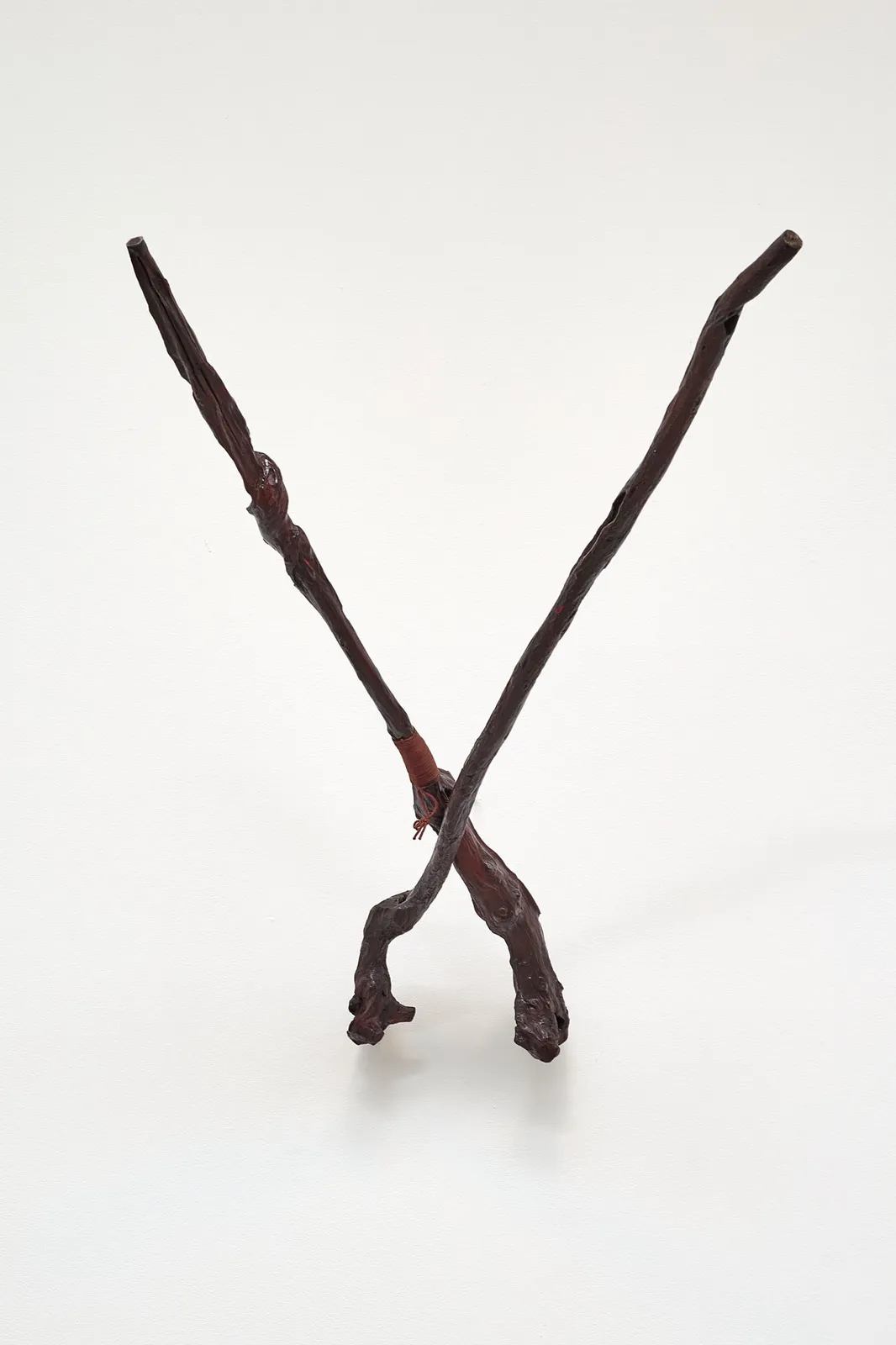
Minouk Lim (b. 1968)
A Fulani Rhyme From West Africa, 2015
Wood
32.28 x 17.32 inches
82 x 44 cm
82 x 44 cm
Minouk perceives broadcast room as both production space and art space because of the idea of memory and history; these two subjects are significant to her personal experiences, given her background of indirectly experiencing the Korean War and other incidents relating to the war.
The placement of individual sculptural objects within this fictional broadcast room came from the idea of Minouk's own imagination—the hope for the communication with each other that has been lost or cannot be found. This notion of bringing communication back came from her subjective experience of Korean War and the divided nation in which her and her parents has lived through. Every binary—whether it's about North and South Korea, Left or Right, older generation and younger generation—needs communication to come up with a resolution that would dissolve any anger and hatred that has been built up.
A sense of lost, despair, and unknown can be felt walking through these ambiguous and abstract objects that are more or less nameless and identity-less. The background of this notion of loss and emphasis on communication derived from her encounter with "Finding Dispersed Families" broadcasted in 1983. The scene of lost families occupying the whole broadcast room came to Minouk as a shock. To Minouk there was a hidden agenda: Dictator Chun's effort to earn the heart of citizens back by offering them a chance to see the lost families, while simultaneously criticizing North Korea's communism. This potentially brought visibility back to these people, but the government having its own agency evinces disconnection with the public. For Minouk, the broadcast room provides a meeting point for communication.
Minouk perceives broadcast room as both production space and art space because of the idea of memory and history; these two subjects are significant to her personal experiences, given her background of indirectly experiencing the Korean War and other incidents relating to the war.
The placement of individual sculptural objects within this fictional broadcast room came from the idea of Minouk's own imagination—the hope for the communication with each other that has been lost or cannot be found. This notion of bringing communication back came from her subjective experience of Korean War and the divided nation in which her and her parents has lived through. Every binary—whether it's about North and South Korea, Left or Right, older generation and younger generation—needs communication to come up with a resolution that would dissolve any anger and hatred that has been built up.
A sense of lost, despair, and unknown can be felt walking through these ambiguous and abstract objects that are more or less nameless and identity-less. The background of this notion of loss and emphasis on communication derived from her encounter with "Finding Dispersed Families" broadcasted in 1983. The scene of lost families occupying the whole broadcast room came to Minouk as a shock. To Minouk there was a hidden agenda: Dictator Chun's effort to earn the heart of citizens back by offering them a chance to see the lost families, while simultaneously criticizing North Korea's communism. This potentially brought visibility back to these people, but the government having its own agency evinces disconnection with the public. For Minouk, the broadcast room provides a meeting point for communication.
Provenance
Acquired directly from the artist
Exhibitions
Minouk Lim: Mamour, Tina Kim Gallery, New York, 2017
2 or 3 Tigers, Haus der Kulturen der Welt, Berlin, Germany, 2017
10th Taipei Biennale, Taipei, Taiwan, 2016
The Promise of If, Plateau, Samsung Museum of Art, 2015
Literature
The Promise of If, Plateau, Samsung Museum of Art, Seoul, Korea, 2015
pp. 88-89
 525 West 21st Street, New York, NY 10011 T 1‑212‑716‑1100 info@tinakimgallery.com
Join our mailing list
* denotes required fields
We will process the personal data you have supplied in accordance with our privacy policy (available on request). You can unsubscribe or change your preferences at any time by clicking the link in our emails.