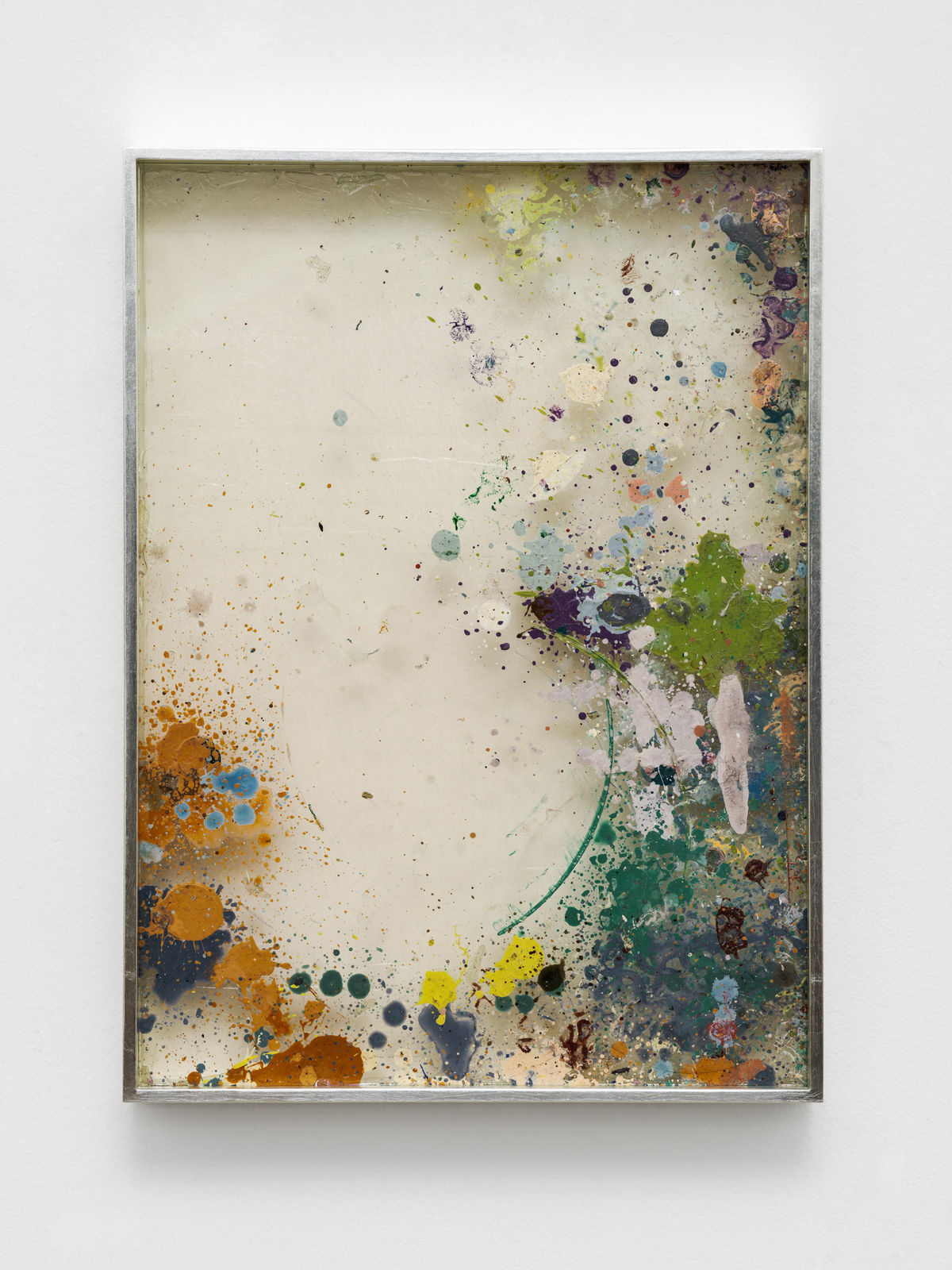
Suki Seokyeong Kang (1977–2025)
21 3/4 x 15 3/4 x 2 1/2 inches
55 x 40 x 6 cm
For the late Korean artist Suki Seokyeong Kang (1977–2025), art was a method of measuring how the individual inhabits the world. Spanning painting, sculpture, installation, video, and choreography, Kang's research-driven practice drew on a distinctly Korean artistic genealogy — from the Jeongganbo, a fifteenth-century grid-system of musical notation, to the hwamunseok, a reed mat used in Chunaengmu, a traditional one-person court dance, to jinkyeong sansuhwa, or "True-View" landscape painting. Across these references, Kang returned again and again to the Korean concept of jari — denoting "place," "seat," or "territory" — to explore the space afforded to the individual within society.
This exploration began with painting, the foundation from which all of Kang's work grew. In linguistics, a "mora" refers to a unit shorter than a single syllable. In Kang's practice, Mora denotes her paintings, referencing the temporal unit of time as the building block of her narrative. Created in the artist's studio in the Seoul neighborhood of Nuha, the Mora—nuha works are composed of layered gouache and dust on acrylic panel — material residue captured from her daily painting practice. Kang painted her canvases laid flat rather than atop an easel, and the flow of paint running down the sides of her frames became a signature of her practice, offering a glimpse into the layers that come together to form her paintings. With this series, the artist extends the gesture beyond the confines of the canvas, layering the accumulated paint with additions of paper and silk. The result serves as a portrait of the artist's time and a poetic monument to the passage of an individual life, rendered in the physical substance of its own making.
Provenance
The artistExhibitions
Suki Seokyeong Kang: Our Spring, Tina Kim Gallery, New York, NY, March 12—April 25, 2026.
