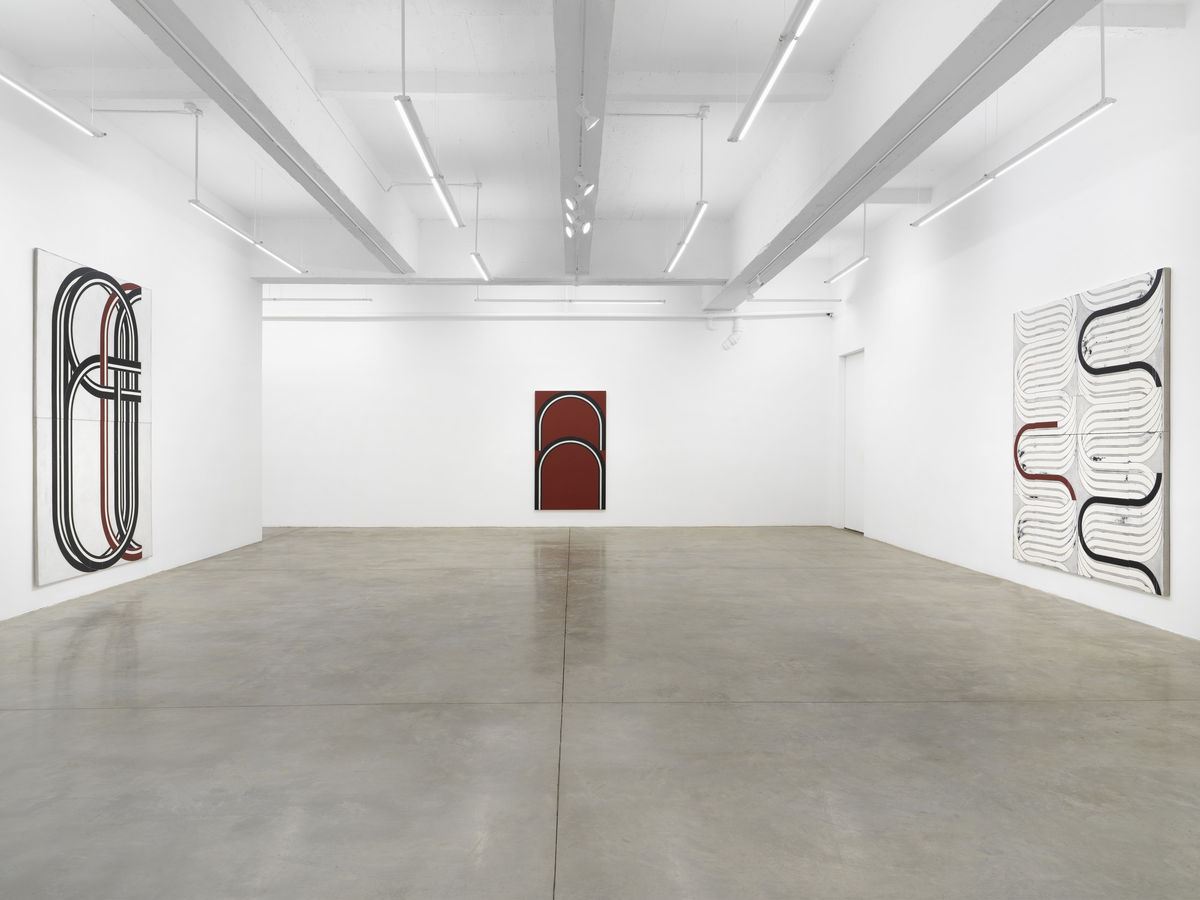
Davide Balliano: Abacus

Tina Kim Gallery is pleased to announce Abacus, an exhibition featuring new paintings and works on paper by New York-based artist Davide Balliano (b. 1983, Turin, Italy). On view from February 5 through March 7, 2026, the exhibition marks Balliano’s fifth solo presentation with the gallery and a significant moment in the evolution of his practice, with the debut of works in color and new series of gouaches on paper.
Long defined by his monochrome palette, Balliano has for the first time introduced shades of red and ochre into his signature geometric paintings, reflecting his ongoing exploration of the tension between order and organic flux. The arches and curves that anchor his compositions, as well as the newly introduced earthy hues, explore the idea of entropic decay and the passage of time while also drawing parallels with the architectural landscape of the artist’s native Turin. The exhibition shares its title with a poem by Sandy Florian, whose meditation on how mathematical instruments can be used to present and represent (or produce and reproduce) the natural phenomena of our world served as a conceptual point of departure for this show.
Balliano’s geometric motifs stem from a sustained interest in the arch, a form he understands as a universal, distinctly human geometry. As an architectural structure determined by human scale, the arch operates as a bridge between the figurative and the abstract. While arches may recall the Roman ruins around his native Turin, Balliano’s interest lies less in their historical specificity than in what ruins symbolize: the passage of time and the inevitability of transformation. These ideas are further explored in the artist’s new gouaches, whose oxidized pigmentation suggests corroded metal or eroded stone. Balliano’s weathered surfaces evoke nature’s inevitable pull toward chaos, even within systems that appear rigorously ordered. The mechanical patterns of his paintings hover on the brink of collapse, only to be reabsorbed into the structure–a tension that expands into a richer chromatic and material vocabulary in this exhibition through the introduction of color and his foray into works on paper. Balliano’s recent incorporation of warm tones was prompted by the friction he perceived between his precise geometric systems and the entropic forces that threaten them. He saw a kind of energetic heat generated by this clash, embodied in the deep reds and ochres seen in this exhibition. The rust oxide pigment, in particular, carries a dual resonance as both natural and man-made, binding human construction and natural decay into a single visual register.
Despite the seemingly mechanical precision of his paintings, Balliano’s process is intensely manual and gradual. The artist begins each work by hand-sketching geometric patterns onto the canvas with the aid of a compass. He underpaints these forms in dark acrylic before meticulously rendering each curve in thin layers of white plaster. After this rigorous, careful stage of painting, Balliano boldly embraces chance: he sands, buffs, and scores the surface, unveiling the stratified layers beneath. In this way, the artist’s approach moves beyond conventional painting, approaching a kind of sculptural excavation. Lastly, he applies diluted washes of paint to sections of the background, whose gravity-driven drips ultimately determine the work’s orientation. Foregrounding the role of natural phenomena, these cascading drips anchor the work in physical experience and bring a sense of lived reality to a visual language that might otherwise feel abstract or detached from the human realm. This extended approach results in entrancingly organic, painterly surfaces, with the artist’s hand evident in the scratches and scores incised into the picture plane.
SALES INQUIRIES
inquiries@tinakimgallery.com | +1 212-716-1100
PRESS INQUIRIES
Hanna Gisel | hanna@hannagisel.com


Installation view of Davide Balliano: Abacus at Tina Kim Gallery, New York (February 5–March 7, 2026). Courtesy of the artist and Tina Kim Gallery. Photo by Dario Lasagni.